Saturday, October 29, 2011

Peru Adventure, Part 1

This morning I sip my first Inca Cola and tonight my first Pisco Sour. And I only cry three times in between.
The first time I heard of these beverages was 1978, when I was supposed to have traveled here to Peru with an expedition from LSU´s Museum of Zoology. My friends wrote to me, on paper, of their adventures. I enrolled in a marine biology field course on the Gulf coast instead, and missed the experience.

Some thirty-three years later, I arrive in Lima, thanks to my adventuring friend Carol. She knew me when I passed up that first trip. She came here just a few years later herself, and has been coming ever since. Now she does these tours for a living, and had space on one that I couldn’t pass up.
Because I signed up late, I am booked on a flight separate from the group from Lima to Puerto Maldonado this morning. After changing planes in Cusco, I am to arrive an hour late, still in plenty of time to join the group for the motorized canoe trip up the Tambopata River. 

As we sit still on the tarmac at the Lima airport, listening to the announcement about the flight delay, I become concerned about making my connection. When we arrive in Cusco over an hour behind schedule, my connecting flight well on its way, I race to the LanPeru counter to implore them to put me on the very next flight. The woman I find tells me the next flight is tomorrow. This is the first time I cry, but not the last.

Lucelia, the gate agent, looks at me with compassion. My mind races through possible scenarios as it dawns on me that I will not be with the group for the lodge tonight or the six hour canoe trip tomorrow to the research station. I explain my situation, that the group will move on without me into the jungle and I do not know how I will reconnect with them. I am not sure that if I miss the boat trip tomorrow that there will be other boats going that way for days. 


I follow Lucelia as she begins working to reschedule my flight. The new direction of the changed trip begins to settle in, and I wait, thirty minutes or more, for the arrangements to be completed. I lean against a wall, the possibility of being stranded in Cusco for a week dawning on me. I cover my face and sob silently into my hand. This is my second cry.

I grieve the loss of the trip I expected and imagine new scenarios for my week. Perhaps a writing retreat in Cusco is what this trip will be, instead of a jungle adventure. I guess that wouldn't be so bad. Lucelia appears again and gives me my new boarding pass, and a hotel voucher, along with ten soles for a taxi, “Five to go now, five to come back here tomorrow.” With this, she tips her hand to the taxi drivers outside who will certainly ask more from this green Gringa tourista. Message received.

It is the second taxi who accepts my bargaining for “cinco (5) soles” after beginning at quince (15). I get to the hotel and rush to find the internet to email Carol and also to get from her earlier email the emergency contact numbers. I print the page of phone numbers and head to my room. 

After reaching the second person I call, who speaks fairly good English, I learn that the arrangements have been adjusted. And there is a boat going all the way to the research station on Tuesday. Carol knows where I am. Someone will meet me at the airport tomorrow morning and I can begin my jungle adventure. I will meet up with the group in two days. I begin to breathe. 

Once I hang up, I weep for the third time today. Except these tears signal release, relief, discharge. I feel grateful, and rescued. My body is shifting gears. I begin to enjoy the idea of the next two days on my own. I think of that Spanish phrasebook I almost bought at the LA airport. I head out to explore Cusco at dusk, and come back to enjoy my first Pisco Sour.


Thursday, July 28, 2011

This is Summer


Farley and I are at Hileman Landing, swimming in our favorite spot. The mercury is rising the closest to 90˚F it has been this year. I am grateful for the sounds of summer: the bullfrog, the mourning dove, the song sparrows. The water feels warm and cool at the same time—the cold spots surprise and the warms spots caress. The heat of the sun soothes my shoulders as I stand up on the rocky bottom and listen.

I stand in the water of the Willamette River’s oxbow listening to these sounds and saying aloud, “This is summer, this is summer,” as if to invite it to stay with me long enough to make the coming winter bearable. The warm water reminds me of summers past. As I speak my mantra I am aware that in my years in the South, this was spring. Summer was something else entirely.

The warm spots remind me of the Tchefuncta River and the swims that helped the eternal summers to be bearable in Louisiana. In my mind’s eye I once again see Brown Thrashers poking around at my mother’s, beneath the lanky pine tree forest that was her yard. The Cardinals and Blue Jays provide splashes of color at her feeders.

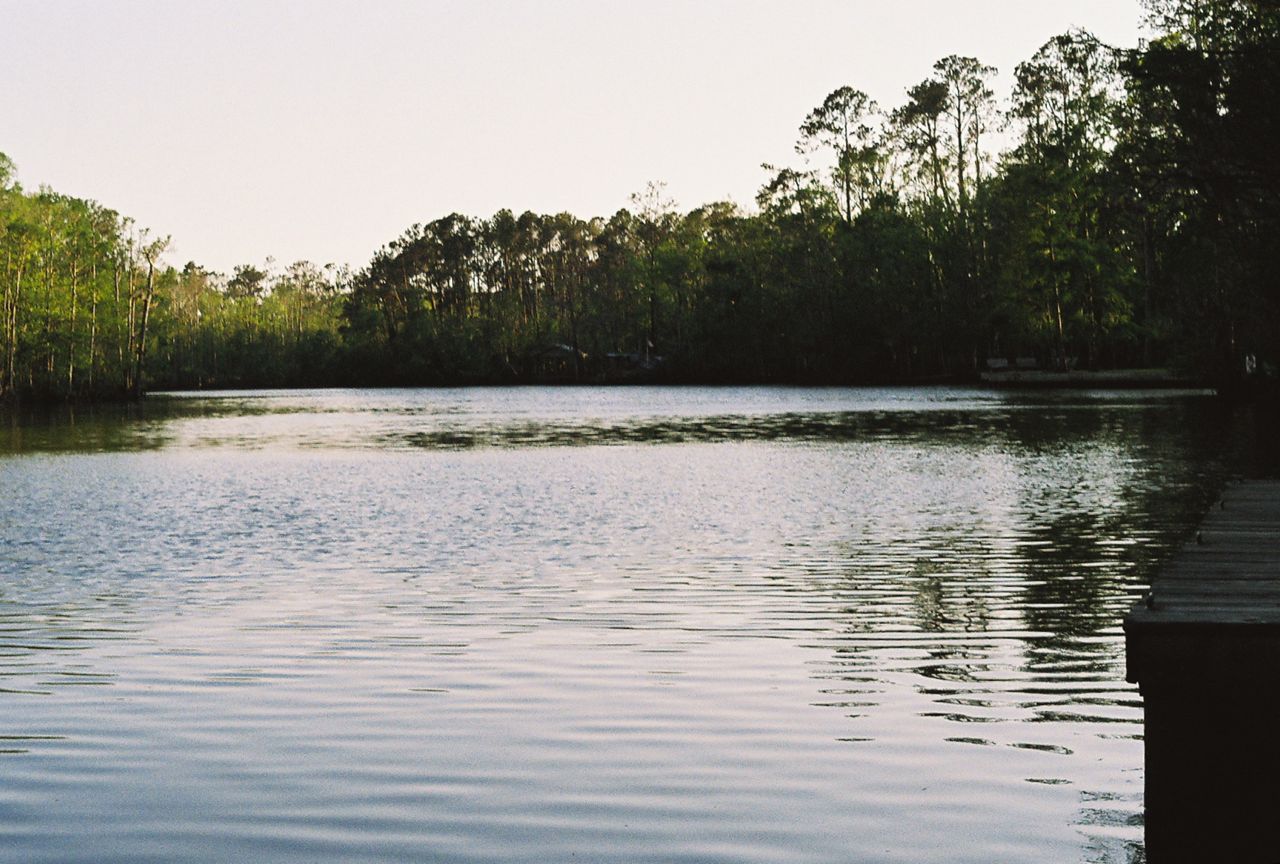
What we called “Lake” Emfred is actually a bayou, branched off the Tchefuncta's  languid main channel. There are two docks next to the boat ramp, one high and one low. The high one on the left is where I would sit to watch for snakes and turtles in the black water in winter, and jump in cannonball style to cool off in summer. Across the bayou the cypress swamp gives the appearance of an island but with little solid ground between the many “knees.” You could pole a pirogue through there to the river easier than finding footing for a hike. Looking to the right of the dock, the bayou has better access to the larger waterway, still through a dark and tangled swamp, an area I loved exploring by canoe.


The three days per summer that I get to be in the water at Hileman take me back to that place of sense memory and I relish it. Most of my Oregonian friends would never swim here, since the bottom is muddy in places and the water is not crystal clear. Most lakes here are translucent and deep and quite cold. After our swim, Farley and I hike out to where the car is parked and meet a family heading in with swimsuits and fishing poles. They ask if they are going the right way to the swimming hole and I reassure them about their direction. They ask how’s the water, and I say great, adding a caveat, “But I’m from Louisiana, so my standards are not high!” We laugh and walk on.

Tuesday, July 5, 2011

The Predator and Its Prey


The sky was blue and the sun was out as I left my favorite coffee shop to walk back to my office. The new summer air had a mild warmth to it, with a coolness in the occasional breeze. Suddenly I heard a ruckus across the street, birds squawking loudly, and I looked over to see what was going on. There were two crows in the middle of the sidewalk in front of the record store, one attacking something and the other one standing by, watching with interest. The way the smaller birds were shouting I took the prey to be their fledgling. 

My heart raced, my hand clutched my chest, and my eyes were glued to the scene. The crow let up for a moment and the prey bolted. As it raced away I realized it was not a bird but a mouse. It scurried behind a nearby utility post that I knew would provide little protection. The noisy starlings were not upset because they were losing a fledgling; they were cheering for the crow, perhaps hoping for a bite of mouse themselves.

The crow bounced over nonchalantly to where the mouse had hidden. Within seconds, it had grabbed the mouse and pulled it back onto the sidewalk. The crow used its beak to hold the mouse and at the same time to pound it against the concrete. It didn’t use its claws, like birds of prey use their talons. With the crow’s method, the mouse got away several times, but it was never long before it was recaptured and pecked brutally again in its soft parts.

Time slowed down as I beheld this violent episode. I could not turn away. It was in fact over within the space of a couple of minutes. I turned to walk on only when it became clear that the crow had won. I was gripped by the horror of the mouse’s fate, eaten alive by this crow, whose motive was not at all evil, but only the satisfaction of its hunger and the nourishment of its body. The mouse had become a meal.

As I walked slowly on, a flood of thoughts and feelings swirled within me. I recalled Barbara Kingsolver’s novel, Prodigal Summer, where her protagonist observes that in the natural world by the luck of the draw some are born predators and others prey. She realizes she must reconcile this reality as part of the design and function of nature, whether she likes it or not. Without one or the other, a delicate balance is thrown off. 

She eventually concludes that as a human manager of her own slice of the natural world, she must respect these roles even in the smallest decisions she makes. She decides she can kill the bugs the spider would eat but not the spider. The wolves in the wilderness she inhabits must be protected as the top predators, but she understands that she can take out a deer for her own sustenance and its population will adjust, because it is designed to serve as prey. It’s how nature works.

My mind bounced again. I tend to think of crows as carrion-eaters, not hunters, but I was reminded that they both hunt and scavenge. After all, they are omnivores and also opportunists; they make their living any way they can.

My thoughts skipped then from respecting the role of the predator to the sad fate of the prey. I couldn’t get the image of the mouse being eaten alive out of my mind. I thought, how in the world can this be okay for the mouse? I can’t imagine a worse fate. I began reflecting on my understanding of the physiology of the fight-flight-freeze response, gained in the course of my work with somatic therapy.

It occurred to me that the mouse has all the same equipment that we do. Thinking physiologically, I ran through the events for the mouse. It was scurrying away as a result of its sympathetic nervous system’s activation: its heart sped up, breathing became shallow, peripheral vision narrowed. All of its reserves and resources were turned toward the act of fleeing from the crow. And flee it did, several times. 

Once running (or fighting, if that had been possible) failed to protect it from the attack, the next step physiologically was automatic dissociation, or “freeze.” With this, the mouse’s heart rate and breathing slowed and endorphins were released to block its perception of pain. Fairly quickly, as the endorphins reached its brain, the mouse was completely sedated and lost consciousness.

As I went through these steps in my brain, I noticed my own release of a long deep breath, as my body began to discharge the impact of the scene I had witnessed. My heart had also sped up, my breathing had become shallow and my vision focused. As I became mindful of my breathing, it returned to normal and I once again felt the warm summer air. My vision opened up to the green leaves of the trees I walked under. I became aware that we can experience the brutality of nature as an aberration, but it is the way of the natural world, as seen in this predator-prey relationship. 

My thoughts settled into the understanding that this world is a complex web of living and dying; one life is given up to sustain another. And I could see that the design is a good one. In fact, how very merciful, in the end, that the prey species would be given such helpful protection from suffering in the midst of its vital role of nourishing the cycle of life.


Sunday, June 12, 2011

Looking back and living now.

     A while back I realized that I had difficult anniversary dates for various losses within every season. I became aware that the memories would return on a regular basis, whether I wanted them to or not. I thought I would be overwhelmed by such year-round grief. But now I understand that grief is intertwined with joy, and in each of these same anniversary seasons there are beautiful things as well. This is life under the sun—pain and beauty intermingled.

     This week marks the anniversary of a close friend’s murder in 1983. Jim was a free spirit, a live wire, and I hope I never forget his wry smile. His deep blue eyes and dark curly hair cast a gentle warm-heartedness, even when his more mischievous side surfaced. He was a cajun who introduced me to sailing on Vermillion Bay and dove the offshore rigs. He once tried teaching me how to hop a freight train. At the last minute I backed out, so he had to jump off a few blocks later to let me catch up with him on the ground.

     It would be easy to reduce his tragic death at 25 to his having gotten mixed up with the wrong crowd. But it was not so simple as that. His killer has never been caught, though a handful of us believe we know what happened. I was tangled up in the aftermath of these events in a way that sank me deep into despair and addiction. A year or so later, I met a stranger in a bar who I now believe was sent from God to tell me it was not my fault, that I could let go of the guilt I hadn’t realized I was carrying. That conversation began my recovery.

     But today, despite the anniversary that reminds me of this tragedy, I am enjoying a deep contentedness. I am grateful for so many things. In particular, I am relieved and thankful for the help I had this week. Teenagers Jordan and Maddi assisted with deck staining. Eleven-year old Coal mowed the grass, with encouragement from his on-site Dad. And Molly spent a whole day of her Eugene visit helping me rebuild the wrap-around deck step. After working for weeks to clear the brush, my summer yard is emerging, and after pounding many nails, I have a repaired deck from which to enjoy it. I take pleasure in projects that can be completed, because my life offers few places where finishing something is accomplished.


     The sprouting garden reminds me of growth and nourishment and the morning sunshine gives a warm place to sip my coffee. I am grateful for friendships that give me company and sustenance along the way. I love having a home where I can welcome visitors, and am looking forward to the arrival of my first summer guests. I am glad when I hear reports that my home has been a refuge to so many over the years.


     So I recall the anniversary of a tragic time, when my life appeared only hopeless and despairing, when I could not have dreamed of a day in the sunshine like today. And I am beyond grateful to find myself having landed in a comfortable, beautiful, and safe place, with a back deck from where I can watch the seasons of my life unfold, pain and beauty mingled together.


Saturday, March 26, 2011

Jan

There is a certain feeling when the spring rain falls on these mountains in western North Carolina. The air smells like chimney smoke and the chill is unexpected. Today it makes me wish for the warmth of yesterday's sunshine. 

My friend Jan is dying. This truth hangs like a thick vapor over our time together. We have always spoken of the “real,” been brutally (and blissfully) honest in our friendship. It is one of the things I love about us.

We are unlikely friends. Born into disparate subcultures, we’ve never had that much in common. And yet I count her among my “life friends.” Despite our contrasts, we share a  deep respect and genuine affection for one another. I have felt strongly the honor of being asked into her life, even twenty-five years ago when we first met. We could have scratched our heads and walked away from each other, but instead we were drawn to figure out our differences and find common ground.

         Indeed the “real” in our friendship is common ground. It came to us harshly in those early years, when Jan was first diagnosed with breast cancer. We were young enough that we didn’t expect such things. And we thought surely this is not the sort of thing a good God does.


         Yet those first years changed us. The questions mounted as Jan faced her grueling treatment, followed by the illness and premature death of her mother, whom she loved dearly. Her questions reflected my own, as I began to acknowledge the impact on me and my own family of the early loss of my brother Steve to leukemia, when I was just a toddler. We thrashed a good bit, struggling to understand how tragedy could signal anything about the existence of a good God.

         Within our different circumstances and contexts (by now I had moved to Oregon), we asked and wrestled and struggled with this God we were trying to trust. And over time  a miracle emerged. Not the miracle of a cure or the removal of our pain, but rather, the miracle that we both kept believing, trying to trust, this God who is okay with our questions, though not especially forthcoming with the answers.

         This time, as I visit and spend time with Jan, I am struck by our relative calmness. Of course it is punctuated by moments of panic and grief, but it is not as thrashing. It seems we are trusting in a different way, with twenty plus years of life in between. The questions are still here, but they don’t seem to matter as much. We have come to accept that we don’t always get answers.

         It doesn’t seem possible to me that this vibrant, joyful and raucous friend of mine is in the process of dying, though we lament it openly. Yesterday she took me to a store on Main Street to buy me North Carolina souvenirs, “because you need to have something to remember this place by, and besides, ‘you can’t take it with you.’” I weep quietly as I sort through the T-shirts, accept the gifts, knowing that I will never forget. 


Addendum: I got to visit Jan one more time, about a month before her death in January of 2012. I think of her often and miss her dearly. 


Monday, March 7, 2011

Winding Roads

There is a winding street that serves as a short-cut on my way to pick up my "foster" daughter from school most days. It takes me by a house I lived in the summer I arrived in Eugene. It was open as a furnished rental for just five weeks, and after two weeks of couch-surfing, I jumped at the chance. It is in a part of Eugene that I have not stayed in touch with, so this route has brought my thoughts back to that season and place.

Twenty two years ago last month I quit my job in fisheries at Clemson University to embark on an adventure. A few months later, I landed in Oregon. I came with a naïve belief in God’s provision, heading west without a place to live, a job, or any real contacts, other than the summer program I was enrolling in to study linguistics.  I suppose I’ve been reflecting on that particular season in my life lately, because I am regularly driving by the house where I landed that first summer.

            I recall sitting in its darkening living room one evening, wondering what in the world I was doing there. The romance of the adventure had worn thin in that moment and I was desperately homesick. The shadows were lengthening as I sat on the floor with my back against someone else’s sofa in a room that shared none of my taste. I am not a materialistic person, so it surprised me that I missed my home—the things that were familiar to me, the security of the income I had left behind.

            By this time that summer I had by chance met Wes and Carol, and learned about this thing called McKenzie Study Center. My shaky faith paradigm was beginning to crack open in places. When I ran out of gas across town because I had no money to fill the tank, it triggered a crisis. It is somewhat embarrassing to admit this, but it showed me that I actually believed God would never let me run out of gas, because I was becoming a missionary and He would provide. That was the deal, right?

            Little did I recognize that since my reluctant conversion to Christianity, I had bought the package and established a quid pro quo arrangement with God. If you scratch my back, I'll scratch yours. I had not yet to asked how this arrangement fit with the gospel of grace I had first been drawn to, the day that God had tackled me against my will. That day, I was immediately committed to the idea that God would do the changing, if any changing was to be done. In just four short years, I had traded that belief for an assumption that somehow my dedication was responsible for keeping me on God's good side.

With Wes and Carol and at MSC, I smelled something different. It looked like these folks didn’t buy the quid pro quo picture. I wanted to understand more. After my summer program was over, I surprised everyone including myself, and decided to stay.

            Ironically, God did provide. I soon had a job in fisheries just up the road in Corvallis, and a house to ship my stored belongings to, one that overlooked a beautiful pasture with a breathtaking view of the Coburg Hills. I took these events and others as signs, signs that God was directing me, though in a very different direction than I had anticipated. Within two years, I joined the staff of McKenzie Study Center. I spent the next eighteen years pursuing a calling that I knew was from God.

            It is no wonder the winding drive by that house brings me back to those days. In another unexpected twist, two years ago last month, I was asked to leave the ministry that I knew was given to me by God. It has been a painful parting. And yet I am certain that as God gives, He also takes away. I am on a different road now, similarly uncertain of what lies ahead. And driving by the little house in west Eugene reminds me that I have been here before. And it reminds me that God provides, though seldom what we expect.


Sunday, January 2, 2011

Thank You Emily Dickinson

Tell all the Truth but tell it slant---
Success in circuit lies
Too bright for our infirm Delight
The Truth's superb surprise
As Lightening to the Children eased
With explanation kind
The Truth must dazzle gradually
Or every man be blind---

-Emily Dickinson

And here is what she wrote to Higginson, apparently in response to his discouraging her about publishing her works:

     I smile when you suggest that I delay "to publish" ---that being foreign to my thought, as Firmament to Fin.
     If fame belonged to me, I could not escape her---if she did not, the longest day would pass me on the chase --- and the approbation of my Dog would forsake me --- then. My Barefoot-Rank is better.
     You think my gait "spasmodic." I am in danger, Sir.
     You think me "uncontrolled." I have no Tribunal. . . .
     The Sailor cannot see the North, but knows the Needle can.